Spencer Museum of Art The University of Kansas

Andrew W. Mellon Department of Academic Programs

How your Colleagues Use the Museum

Women in America earn only 2/3 of what men do by Guerrilla Girls Guerrilla Girls
Women in America earn only ⅔ of what
men do
We selected works of art as information resources for a semester-long project. While some images had tangential relationships to astronomy or space exploration, they were chosen not because they relate specifically to a particular course topic, but because they express a complex set of ideas with a clear message in a cogent manner. The goal was to inspire students as to how they could use alternative media to convey complex material in a way that moved beyond the traditional term paper.
Gregory Rudnick
Assistant Professor, Physics and Astronomy
ASTR 191 “Contemporary Astronomy”

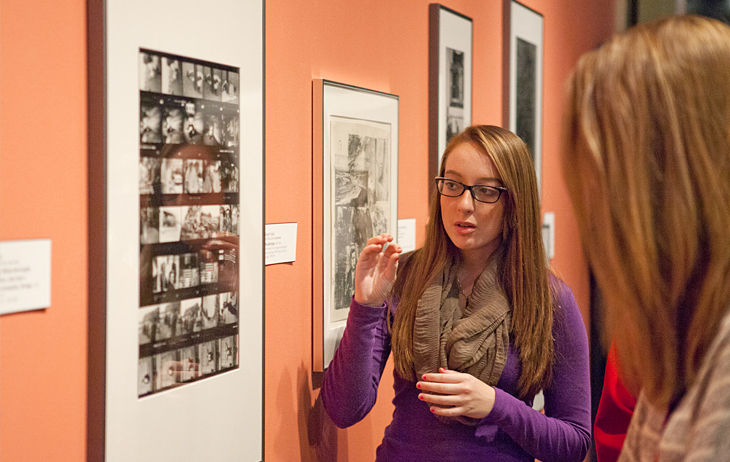
It's always a joy to come over to the Spencer with the students. It is amazing what they perceive. Each time I encounter the 20/21 landscape with them I am introduced to new understandings and most appreciate the experience. Students pay attention to all aspects of the gallery, from object installation and the relation to the visitor, to floor labels, technology and levels of audience participation, all as examples of the museum as an educational landscape.
William I. Woods
Professor, Department of Geography
Courtesy Professor, Department of Anthropology
GEOG 379 “Cultural Geography”
Howl by Luis Alfonso Jimenez Luis Alfonso Jimenez
Howl

The Bonham Project by Jon O'Neal Jon O'Neal
The Bonham Project
I have had the fortune to work with the Spencer Museum for over a decade, and the interaction has enriched my career and enabled me to provide an interdisciplinary perspective of health care to the pharmacy students. The Museum has facilitated this by enthusiastically providing a host of resources, from faculty expertise, to learning space, to artwork, that augment the pharmacy-specific course content. While my methods of using visual art in class have evolved over time, the fundamental learning objectives have remained much the same. My goals are to improve students’ visual literacy and utilize art to stimulate conversation, reflection, and ultimately understanding of the human dimension of illness and suffering.
Barbara Woods
Director, Postgraduate Education and
Clinical Assistant Professor, School of Pharmacy
PHPR 515 “Pharmacy and the Arts”

In anticipation of our NSF-sponsored Alaska workshop, “Understanding Rapid Environmental and Social Change in the Arctic: Bridging Traditional Knowledge and Interdisciplinary Science across IGERTs,” two of our graduate students worked with the Museum’s curatorial staff to select objects for a teaching gallery viewing and class discussions.

The workshop was a big success, as was the poster based on the curatorial support. Working with SMA objects added a unique and invaluable dimension to our scientific work.

Joane Nagel
University Distinguished Professor, Sociology
Director, National Science Foundation
Integrative Graduate Education and Research Training (IGERT)
Program for Climate Change, Humans, and
Nature in the Global Environment
Teaching Gallery Installation: “Knowing the Arctic: Lewis L. Dyche,
Western Science, and Indigenous Knowledge”
pair of boots with liners by Inuit peoples Inuit peoples
pair of boots with liners

sowei mask by Temne peoples Temne peoples
sowei mask
The tour, lecture, and discussion facilitation of the installation African Healing Journeys was an outstanding addition to my class on gender and African politics. There were so many interesting and unexpected linkages for our class. Living in balance with nature, understanding and creating health, discussing and making sense of disease, community responses to health problems—all of these are ideal for our class. I did not expect to also have the opportunity to examine ideas of beauty—and how beauty can be part of community building. I enjoyed bringing these themes up for the rest of the semester.
Hannah Britton
Associate Professor, Political Science and
Women, Gender, and Sexuality Studies
POLS 699 “Gender and African Politics”

The group was fired up about the museum assignment to find ethical dilemmas in art. It made them consider both with fresh eyes. They bantered about paintings and sculpture and contained values until I had to move them along to the next subject. Several of them returned to the comment of art as a means of exploring self. For a teacher, it just doesn’t get much better than this: active intelligences combined with great ideas—which lie at the heart of meaningful art—leading to a natural and eager outflow of profound discourse.
Charles Jones
Director, KU Public Management Center,
Department of Public Administration
PUAD 841 “Role, Context and Ethics of
Public Administration” and National Urban Fellows
Morning in the Adirondacks by Sanford Robinson Gifford Sanford Robinson Gifford
Morning in the Adirondacks

Madonna and Child between Two Angels, with a Kneeling Donor, His Wife and Child by Guiduccio Palmerucci Guiduccio Palmerucci
Madonna and Child between Two Angels, with a Kneeling Donor, His Wife and Child
The discussion in the galleries of how the Museum acquires art was directly relevant to the topics in class relating to charitable donations. In class later, we continued the discussion of how once a gift is given, the cost to the donee organization to maintain the gift should also be considered. The distinction between restricted and unrestricted gifts was also something the students found enlightening.
Janie Whiteaker-Poe
PhD Candidate, School of Business
ACCT 330 “Introduction to Taxation”

SMA staff have no end of great suggestions, and their expertise, willingness to help, and enthusiasm make the prospect of future collaboration truly exciting. Curator Susan Earle engaged students in two of my German classes, speaking about paintings, sculpture, and jewelry in a manner that helped all of us look at and think about art in new ways. She even took a Spitzweg out of storage for my students. This was especially exciting, as I was planning to show them slides of Spitzweg paintings in our next class, as part of our discussion of Biedermeier culture. That evening some of my students sent me emails saying that they had enjoyed the tour; one provided a link for Susan to an English translation of a poem that had been mentioned in conjunction with Hébert’s bronze. The tour also inspired a graduate student, on his own, to bring his undergraduate class to the SMA later that semester for a lively discussion of works on display.
Lorie A. Vanchena
Associate Professor, Germanic Languages and Literatures
GERM 572 “German Literature from 1805-1890” and
GERM 136 / AMS 344 “The German-American Experience”
Et Toujours! Et Jamais! by Pierre Eugène Emile Hébert Pierre Eugène Emile Hébert
Et Toujours! Et Jamais!

Beim Dengeln (Whetting the Scythe) by Käthe Kollwitz Käthe Kollwitz
Beim Dengeln (Whetting the Scythe)
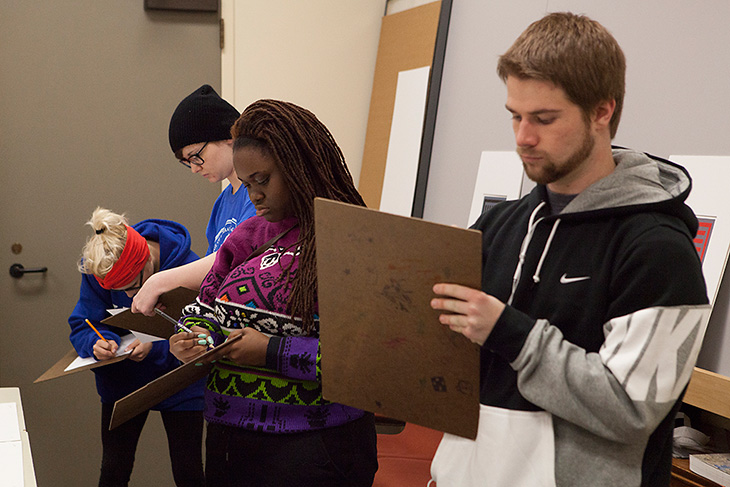
My students and I alike have benefited enormously from our visits to the Spencer. I have learned new ways to bring about more student engagement and see joint efforts with the Spencer having real impact upon my students. They have been able to make connections between the language of visual art and that of the theatre; provocative discussions about gesture, focus, tone, mood, emotion, centers of the body and character invariably follow. One of my students told me that he thought ALL the acting classes should visit, not just Movement.

The Spencer is able to create an astoundingly individualized focus for particular needs. Several of my classes have been able to improvise and/or perform in the Spencer’s beautiful and constantly changing central gallery. The staff at the Spencer is remarkably knowledgeable, creative, passionate, and eager to engage with faculty and students across the disciplines.

Leslie Bennett
Assistant Professor, Department of Theatre
THR 213 “Movement I: The Acting Instrument”