
K-12
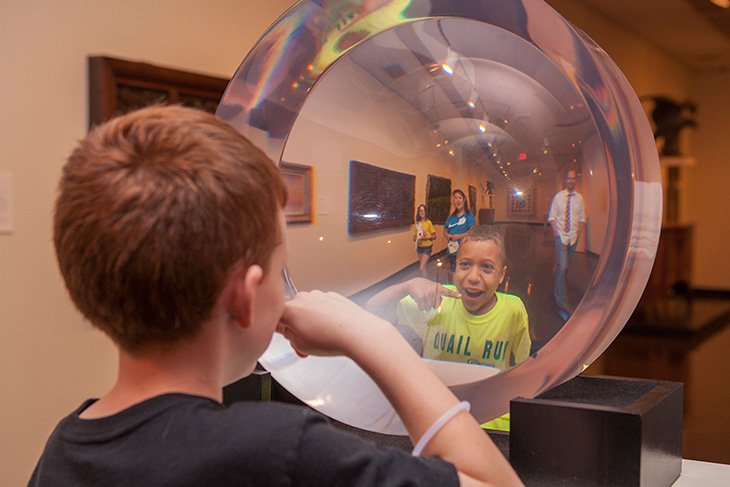
An appreciation and understanding of art begins early, and children of all ages can enjoy and benefit from the Museum’s exhibitions and programs. Spencer educators and docents enthusiastically work with K–12 teachers to deliver fun and informative arts activities for their students at the Museum and in local classrooms. We also offer a number of resources that can enrich classroom teaching about core subjects.
Class Visits
The Museum offers a variety of learning opportunities for students of all ages. With the Museum’s deep and diverse collection, students can explore art and ideas from a range of cultures, time periods, and perspectives. Spencer staff look forward to working with you and developing a class visit that meets your learning goals.
Museum/Schools Program
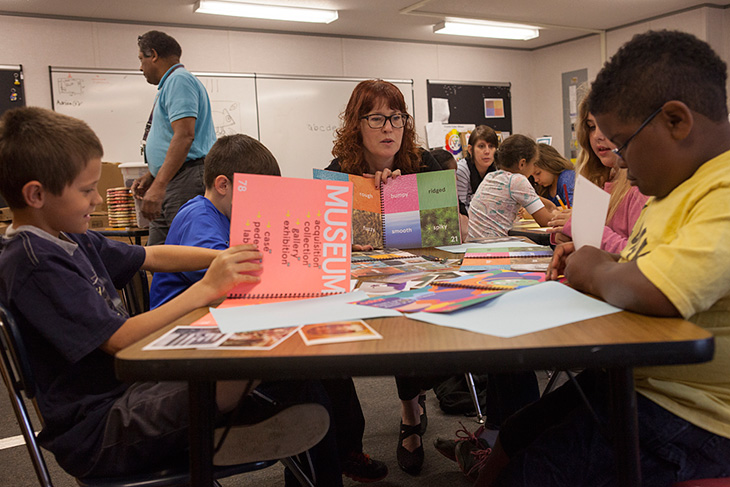
The Spencer Museum of Art benefits from a more than 50-year partnership with the Lawrence Public Schools System. In 2012, a team of Spencer educators and USD 497 art teachers expanded the program to better align with the needs of students by creating the Museum/Schools Partnership for 21st-Century Learners (MSP21). MSP21 is an integrated, participatory, arts-based learning program for elementary school students to improve their knowledge and skills and promote lifelong learning in the arts.
MSP21 includes many collaborative activities and four annual programs.
Art Museum Stories
Art Museum Stories reinforces visual art and English language arts learning for third-grade students by introducing them to the Spencer and the narratives shared through works of art and museums.
Art of Kansas and the Region
Art of Kansas and the Region focuses on works by Kansans or about Kansas, as well as works by regionalist artists John Steuart Curry, Thomas Hart Benton, and Grant Wood, in conjunction with fourth-graders’ exploration of Kansas and the Midwest in social studies.
The Detective’s Eye Tour
The Detective’s Eye Tour centers on works of art with connections to STEM fields and supports key learning goals for fifth-grade science, reading, and visual art curricula. Fifth-grade students take on the role of detective and use observation and critical-thinking skills to uncover clues and discover stories hidden in works of art.
Bulldog Art Tours
Bulldog Art Tours are created by eighth-grade students at Southwest Middle School as part of an annual communications project. Students record episodes that describe a work of art in the Spencer’s collection from their first-hand perspectives. Bulldog Art Tours are also accessible via the Spencer’s mobile app.
K-12 Resources
With a collection that is both local and global and a dedicated team of educators and docents, the Spencer is well-equipped to advance classroom teaching and learning across a range of subjects.